

REVIEW · BUCHAREST CITY TOURS
5h Bucharest City Tour by Car/Minivan – Small Group max 7 people
Bucharest in five hours is fast, but fair. This small-group drive gives you a big-picture feel for the city, with a guide explaining culture and history as you hop between major sights and a few surprising corners. I like that it mixes famous institutions with everyday Bucharest, so you get more than postcard photos in one outing.
The two big wins for me are hotel pickup and the small-group size (max 7), which keeps the ride from feeling like a cattle car. I also like the way the guide handled timing—Sebastian was on time, communicated by WhatsApp, and even adjusted plans when closures popped up so the full tour time still mattered. One possible drawback: most stops are short (around 15 minutes), so if you want long, slow wandering, you’ll feel the time pressure.
In This Review
- Key Points at a Glance
- Price and What You Actually Get in 5 Hours
- A 7-Person Car Tour That Helps You Get Oriented Fast
- Parliament to Cathedral: Understanding Romania’s Power Meets Its Faith
- Ferentari and Carol Park: A City With Contrasts, Not Just Icons
- Văcărești Natural Park: Wildlife Where You’d Least Expect It
- Old Roots Near Radu Vodă: Bucur the Shepherd’s Church
- Unirii Square and University Square: Two Centers, Two Moods
- Ceaușescu’s Mansion: The Spring Palace Shows the Dictator Side
- Village Museum in 1 Hour: Rural Romania Without the Long Trip
- Triumph Arch, Opera, and Athenaeum: A Night-at-the-Theater Feel in Broad Daylight
- Revolution Square and Calea Victoriei: Where History Feels Close
- Finishing at the Right Mood: A Tour That Gives You a Map for Later
- Who Should Book This Tour (and Who Might Not)
- Should You Book This 5h Bucharest City Tour?
- FAQ
- How long is the Bucharest city tour?
- What time does the tour start?
- How many people are in the group?
- Is the tour offered in English?
- Does the tour include hotel pickup?
- Is there a panoramic tour by car or minivan?
- Are tickets included for all stops?
- Is lunch included?
- Is mobile ticketing available?
- What’s the cancellation window?
Key Points at a Glance
- Small group (max 7) keeps the explanations personal, not robotic
- Hotel pickup means less time figuring out logistics and more time seeing Bucharest
- Fast-moving itinerary with mostly 15-minute stops gives you a wide overview
- Nature in the middle of the city at Văcărești Natural Park, also called the Delta of Bucharest
- Romania across eras from Communist monuments to Orthodox churches and WWI memorials
- Extra paid entries are limited to the Village Museum and the Romanian Athenaeum
The big Bucharest sights in one sweep
- Bucharest: City Highlights Guided Walking Tour★ 4.9 · 1,482 reviews
- Bucharest: Communism and History Guided City Walking Tour★ 4.9 · 918 reviews
- Bucharest Highlights Walking Tour★ 5.0 · 469 reviews
- Bucharest: 2-Hour City Highlights Bike Tour★ 4.8 · 269 reviews
Price and What You Actually Get in 5 Hours
This tour costs $95.12 per person for about 5 hours, which is a good match for first-time visitors who want a guided orientation without doing a whole day of ticket lines and route planning. You’re paying for three things: a professional English guide, a car/minivan panoramic tour with multiple stops, and hotel pickup.
That value is stronger because the itinerary lists free admission for many key stops. The two exceptions to plan for are the Village Museum (40 RON, about €8 per person) and the Romanian Athenaeum (15 RON, cash only, about €3 per person). Lunch is not included, so you’ll want to eat before or after. If you come prepared for two small entry fees, the $95.12 starts to look pretty reasonable for what you cover.
One other useful clue: this tour is often booked well in advance (around 49 days). High demand usually means the format works—especially the small-group setup and the fact that it runs as a guided “see the whole city” loop.
A 7-Person Car Tour That Helps You Get Oriented Fast
Bucharest can feel spread out, and trying to self-navigate your first day can turn into a lot of time waiting at crossings, hunting for parking, or zig-zagging across neighborhoods. This is designed to avoid that. You start at 9:30 am, and you get picked up from a centrally located hotel (the key part for most people is that you don’t waste your morning tracking down a meeting point).
With a max of 7 people, you’re more likely to get tailored answers from your guide, and you can hear the commentary without craning your neck. The tour also uses short stops for photos and stories, which is exactly what you want when you’re trying to understand how Bucharest connects—politically, spiritually, and socially—across different parts of town.
Just keep one expectation realistic: the pace is brisk. Many sights are about 15 minutes, so the goal is context, not deep study. If you’re the type who likes to linger inside museums for hours, you might use this tour as a first-day “map,” then come back later on your own.
Parliament to Cathedral: Understanding Romania’s Power Meets Its Faith
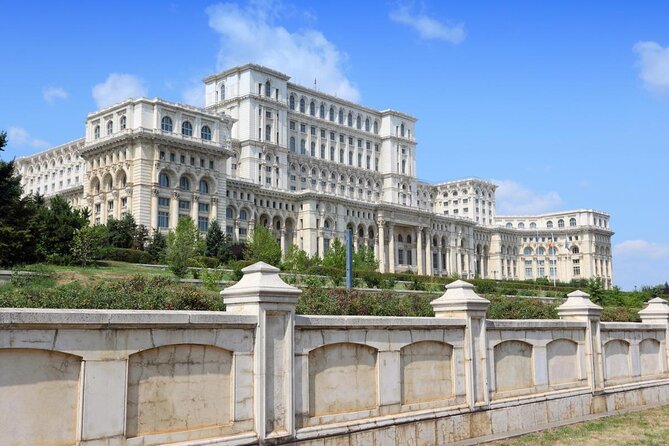
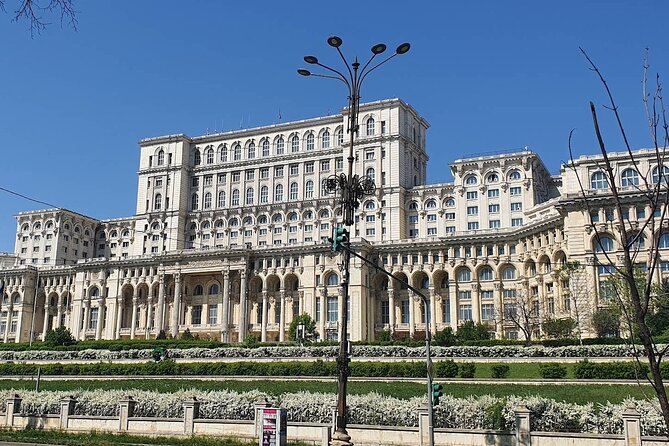
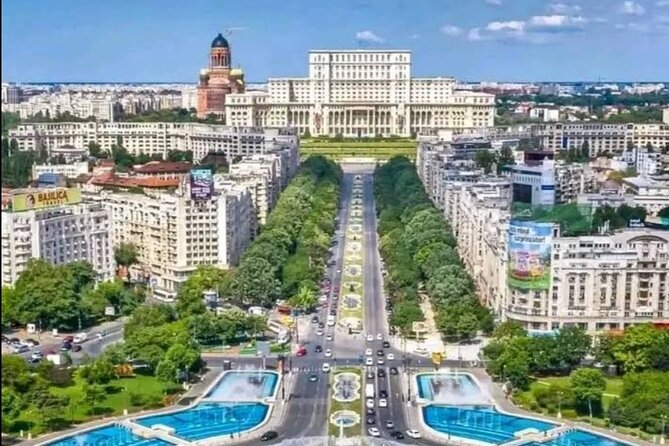
The itinerary begins near the center of political gravity: the Palace of Parliament. Even if you don’t go inside, the stop is meaningful. This building is described as the heaviest in the world, weighing about 4,098,500,000 kilograms. Your guide can connect that size to the political ambitions of the era that produced it—and why it still dominates Bucharest’s skyline.
Right after that, you head to the People’s Salvation Cathedral (Catedrala Mântuirii Neamului). The cathedral is monumental in a different way: designed as the largest Orthodox church in the world, with construction beginning in 2010 and consecration in 2018. The Byzantine-inspired look is the visual hook, but the deeper value is the story of national identity and spiritual unity—set right beside the political landmark you just saw.
Why this pairing works: it forces you to compare two types of “power.” One is governmental and architectural, built to command space. The other is religious and symbolic, built to command meaning. You’ll leave this section with a clearer idea of why Bucharest’s biggest structures feel linked, even when they’re telling different stories.
Tip for your photos: both stops are tight-time moments, so keep your camera ready and pay attention to the angle your guide recommends before you rush out for pictures.
Ferentari and Carol Park: A City With Contrasts, Not Just Icons
Next comes Ferentari, in southern Bucharest. This stop isn’t about a famous building; it’s about understanding context. Ferentari has a reputation tied to poverty and social challenges, plus limits in infrastructure and public services. The more useful way to see this stop is as an introduction to the reality that cities aren’t just their monuments.
The point isn’t to sensationalize. It’s to notice how the city contains both hardship and resilience, and how efforts toward social inclusion continue. If you approach this respectfully, it can change the way you interpret everything else you’ll see later. If you’re uncomfortable with sensitive topics, you might find the tone of the explanations heavy—though the time spent is short.
Then you move to Carol Park (Parcul Carol) and the monument there. This is one of those Bucharest contradictions you’ll appreciate: a site that began as a mausoleum dedicated to Communist leaders, then changed meaning after 1989. Since 2006, it has served as the Tomb of the Unknown Soldier, honoring Romanian soldiers who died in battle. A tall red granite structure on a stone pedestal anchors the view, but the real takeaway is how Bucharest repurposed symbols rather than just destroying them.

Văcărești Natural Park: Wildlife Where You’d Least Expect It
After the heavier political and social stops, the tour gives you a breather at Văcărești Natural Park (often nicknamed the Delta of Bucharest). It’s an urban nature reserve of about 190 hectares and formed on the site of an unfinished communist-era reservoir.
Here’s what makes this stop feel different from the rest: it’s not a single building or statue. It’s a living system—birds, amphibians, and rare plants—inside a major European capital. Even with only around 15 minutes, you can grasp the idea that Bucharest isn’t only architecture. It’s also ecology, even when that ecology grew out of abandoned infrastructure.
If you like the idea of nature without getting on a train, this is the kind of stop you’ll remember. It also gives your day a calmer rhythm between monuments.
Old Roots Near Radu Vodă: Bucur the Shepherd’s Church
The next stop is Biserica Bucur (Biserica lui Bucur Ciobanul), a small Orthodox church near Radu Vodă Monastery. This one works because it’s intimate. The legend says the shepherd Bucur helped give the city its name, though origins are debated. What matters is the church dates back to the 18th century and is among the oldest surviving religious buildings in Bucharest.
The architecture is simple, and that simplicity is the point. Instead of overwhelming you with scale, it gives you a human-sized spiritual landmark where you can feel the age of the place—at least through your guide’s story and the atmosphere around it.
Unirii Square and University Square: Two Centers, Two Moods

Then the tour swings back into the city’s everyday stage power at two major squares.
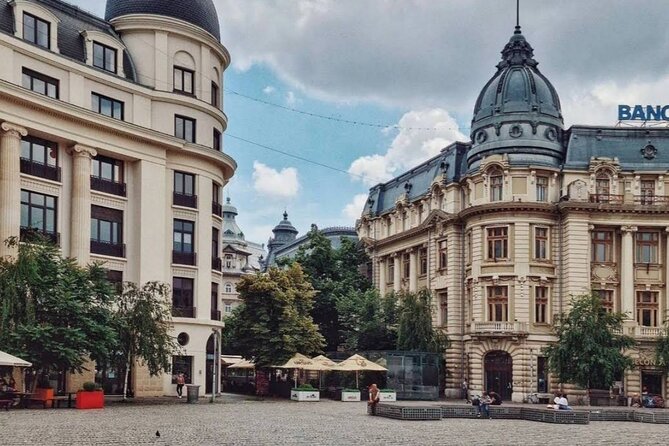
Piața Unirii (Unirii Square) is one of Bucharest’s largest and most important public squares. It’s also a transportation and commerce hub, with shopping centers nearby and impressive boulevard views. The large fountains and open space make it a place that looks busy even when you’re just driving past. This is where your guide can explain how Bucharest’s center holds daily life and tourist life at the same time.
After that you go to Piața Universității (University Square), in front of the University of Bucharest. This stop is known for its role in Romania’s 1989 Revolution and later demonstrations. You’ll also see statues and key civic buildings like the National Theatre, plus the feeling that this is a meeting point for civic and student energy.
Why both squares matter: Unirii Square gives you modern urban function; University Square gives you political memory. Together, they help you understand how Bucharest’s public spaces act like chapters in the same book.
Ceaușescu’s Mansion: The Spring Palace Shows the Dictator Side
The tour continues to Ceaușescu’s Mansion (Palatul Primăverii), also called the Spring Palace. This former residence of Nicolae Ceaușescu opened to the public in 2016, and the itinerary notes it was kept secret during his rule.
Inside, it’s described as extremely luxurious, with opulent interiors, grand halls, a private cinema, and even a lavish indoor pool. Today, it operates as a museum offering insight into Romania’s communist past.
Even with a short stop time, this is a strong “lesson stop.” It puts a face and lifestyle to the system you may only know about from history class. The discomfort is part of the value here: it helps you connect political events to real rooms, real spending, and real power.
Village Museum in 1 Hour: Rural Romania Without the Long Trip
A major shift comes at Muzeul Național al Satului Dimitrie Gusti (Village Museum). This is the only stop that gets around an hour, and it’s the one that most often turns a city tour into an experience you’ll recommend later.
It’s an open-air ethnographic museum with over 200 authentic houses, farms, and churches brought from different regions of Romania. It was founded in 1936 and sits along the shores of Herăstrău Lake. Even if you only get one hour, you can see how Romania’s rural architecture and culture shaped the country’s identity.
This is also where you should budget the extra entrance cost: the fee is listed as 40 RON (about €8) per person. Since it’s not included, you’ll want to decide in advance whether you’ll prioritize it as part of your Bucharest plan. For me, this is the stop most worth the add-on money because it gives you something you can’t recreate by just walking around central Bucharest.
Triumph Arch, Opera, and Athenaeum: A Night-at-the-Theater Feel in Broad Daylight
The tour then moves toward Bucharest’s grander ceremonial and cultural sites.
First, there’s the Arch of Triumph (Arcul de Triumf), originally built in 1922 to honor World War I soldiers. It was later rebuilt in granite in 1936 and stands 27 meters tall, with sculptural decorations by Romanian artists. This is a monument that teaches you how Bucharest learned to celebrate national pride and military memory through architecture.
Next comes Opera Națională București, Romania’s premier opera and ballet theater, founded in 1921. The building is elegant, and your guide can point out why the opera program matters in a city’s cultural identity—even if you don’t catch a performance.
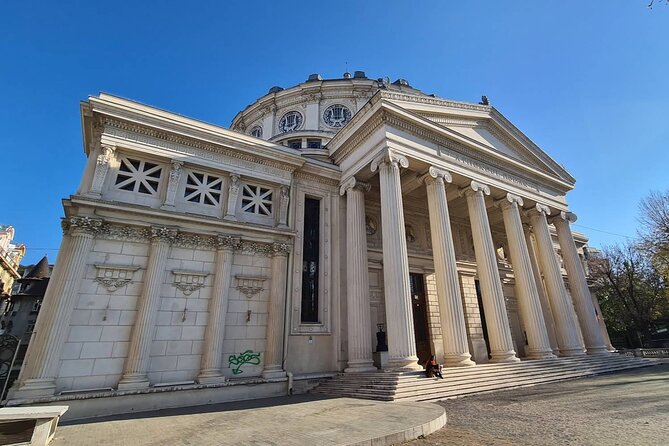
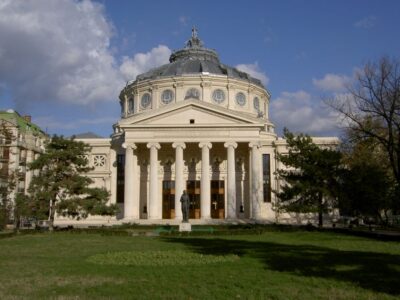
Then you reach Ateneul Român (Romanian Athenaeum), a famous concert hall built in 1888, with neoclassical architecture and a domed roof. It’s home to the George Enescu Philharmonic Orchestra and hosts concerts and events. Admission isn’t included here; the itinerary lists 15 RON cash only (about €3 per person). It also gives you around 30 minutes, which is enough time to appreciate the exterior and decide whether you want to add entry.
If you’re deciding whether to pay for this one, think of it as your music-and-architecture checkpoint. The exterior alone is striking, but entry is where you’ll likely feel the full impact.
Revolution Square and Calea Victoriei: Where History Feels Close
After the cultural stops, the tour hits Piața Revoluției (Revolution Square). This square is the main site of the 1989 Romanian Revolution that ended communist rule. It’s surrounded by important buildings and includes memorials and statues honoring the revolution’s heroes.
This stop can land hard, even in 15 minutes. That short time is part of the value: you get the emotional and historical framing without your day turning into a full history lecture. Your guide’s explanations matter here—so pay attention rather than just looking around.
Then you go along Calea Victoriei, one of Bucharest’s most famous historic streets. It’s lined with important landmarks, museums, shops, and cafes, and it has a key cultural and commercial role since the 17th century. Even if your feet don’t get the longest workout, driving or stopping briefly along the street helps you visualize where Bucharest’s formal city life shows up.
Finishing at the Right Mood: A Tour That Gives You a Map for Later
A big reason this tour works is pacing: it starts with the heavyweights (Parliament), then moves into spirituality, social reality, memory, nature, and culture. You end up with a mental map you can use for later self-guided exploration.
This matters because Bucharest rewards follow-up. After you see Ceaușescu’s mansion, Revolution Square hits differently. After you see Văcărești Natural Park, you’ll notice green pockets more. After Village Museum, you’ll understand rural culture as part of the national story rather than as a separate topic.
Who Should Book This Tour (and Who Might Not)
This tour is a great fit if you:
- Want a guided overview of Bucharest in about half a day
- Prefer a small group (max 7) with real time for questions
- Like history and culture but don’t want to plan routes and ticket logistics
- Appreciate a mix of major monuments and unexpected stops like Ferentari and Văcărești
It might be less ideal if you:
- Want long stays at each attraction (this is mostly 15 minutes per stop)
- Hate paying for extra entrances, especially if you skip both the Village Museum and the Athenaeum
- Don’t want any stops related to social hardship (Ferentari is brief, but the topic is real)
Should You Book This 5h Bucharest City Tour?
I think you should book it if you’re trying to orient yourself on day one (or day two) and you want a guided route that covers the city’s major storylines. The $95.12 price makes sense when you compare it to hiring private transport and paying separately for lots of fragmented stops. The small-group limit and English guide also help keep it from turning into a rushed bus ride.
I would book with the right mindset: treat it as a guided “first pass.” Then, if something grabs you—maybe the Revolution sites, the churches, or the rural museum—you’ll know exactly where to spend more time next.
If your schedule is tight and you don’t want to wrestle with logistics, this is a solid, practical way to see Bucharest.
FAQ
How long is the Bucharest city tour?
It runs for about 5 hours (approx.).
What time does the tour start?
The start time is 9:30 am.
How many people are in the group?
It’s a small group with a maximum of 7 travelers.
Is the tour offered in English?
Yes, it’s offered in English.
Does the tour include hotel pickup?
Yes, hotel pickup is included.
Is there a panoramic tour by car or minivan?
Yes. You’ll have a panoramic tour by car/van with stops for pictures and stories.
Are tickets included for all stops?
Many stops are listed as free, but the Village Museum entrance (40 RON) and the Romanian Athenaeum entrance (15 RON cash only) are not included.
Is lunch included?
No, lunch is not included.
Is mobile ticketing available?
Yes, the tour includes a mobile ticket.
What’s the cancellation window?
You can cancel for a full refund up to 24 hours before the experience starts.
More Tour Reviews in Bucharest
- Bucharest: Dracula’s Castle, Peles Castle, & Brasov Old Town
★ 4.5 · 17,858 reviews - Bucharest: Dracula Castle, Peles Castle & Brasov Old Town
★ 4.6 · 10,891 reviews - Bucharest: Dracula’s Castle, Peleș Castle & Brașov Day Trip
★ 4.4 · 6,100 reviews - Bucharest: Palace of Parliament Tickets and Guide
★ 4.3 · 3,182 reviews - Bucharest: Day Trip to Dracula Castle, Peles Castle & Brașov
★ 4.4 · 3,049 reviews - Bucharest to Dracula Castle, Peles Castle and Brasov Guided Tour
★ 4.5 · 2,933 reviews
All of Bucharest in a Day
- Bucharest: City Highlights Guided Walking Tour
★ 4.9 · 1,482 reviews - Bucharest: Communism and History Guided City Walking Tour
★ 4.9 · 918 reviews - Bucharest Highlights Walking Tour
★ 5.0 · 469 reviews - Bucharest: 2-Hour City Highlights Bike Tour
★ 4.8 · 269 reviews - Best of Bucharest | Private Walking Tour
★ 5.0 · 199 reviews - Bucharest Tuk Tuk city tour
★ 5.0 · 188 reviews
Just In: The Latest Bucharest Reviews


Bucharest City Tours, compared.
 ★ 4.9City Highlights Guided Walking TourFrom $211,482 reviews
 ★ 4.9Communism and History Guided City Walking TourFrom $31918 reviews
 ★ 5.0Bucharest Highlights Walking TourFrom $21469 reviews
 ★ 4.82-Hour City Highlights Bike TourFrom $33269 reviews
 ★ 5.0Best of Bucharest | Private Walking TourFrom $314199 reviews
 ★ 5.0Bucharest Tuk Tuk city tourFrom $54188 reviews
★ 4.9Bucharest Tuk Tuk City TourFrom $58167 reviews
★ 5.0Bucharest Tuk Tuk city tourFrom $54188 reviews
★ 4.9Bucharest Tuk Tuk City TourFrom $58167 reviews
 ★ 4.7Small Group History, Art & Secrets TourFrom $22152 reviews
Browse the lists this tour appears in