
REVIEW · BUCHAREST CITY TOURS
2-Hours Private Bucharest City Tour
Bucharest history hits hard in two hours. This private tour lines up the People’s House story of communism’s damage, plus Romanian identity stops that feel grounded and human. You also get a tight route through major landmarks, explained in English with enough context to make the city click.
I love the round-trip hotel pickup, because it keeps the whole trip simple and stress-free from minute one. I also like having a private, licensed guide who can tailor what you focus on while you ride in your own car with just your group.
One possible drawback: with only about 2 hours, you’ll see highlights quickly, not long museum time. If you’re the type who wants to linger, plan to add extra time on your own.
In This Review
- Key things to know before you go
- Start with hotel pickup and a route your group can shape
- The People’s House in Bucharest: how one regime built its own mirror
- National Village Museum: Romanian homes, sustainability, and identity
- Senate Palace and December 1989: where the revolution began
- Ceaușescu Mansion: the private life behind the regime
- Arch of Triumph and the Romanian Athenaeum: culture, memory, and symbolism
- Bucharest around the Royal Palace and old-city institutions
- Price and value: when $140.58 makes sense
- Should you book this private 2-hour Bucharest tour?
- FAQ
- What’s included in the tour price?
- Does the tour offer hotel pickup and drop-off?
- How long is the Bucharest city tour?
- What language is the guide?
- Is this a private tour or a shared group tour?
- Can I cancel for a full refund?
Key things to know before you go
- Private car, just your group for a smooth, no-guessing route through central Bucharest
- Hotel pickup and round-trip transfers so you aren’t timing buses or lining up taxis
- English-speaking licensed guide/driver throughout to connect the dots between sites
- Flexible itinerary mid-tour, so you can lean more into politics, culture, or monuments
- Transport fees handled (fuel, parking, road tolls, taxes), so nothing comes up at the curb
The big Bucharest sights in one sweep
- Bucharest: City Highlights Guided Walking Tour★ 4.9 · 1,482 reviews
- Bucharest: Communism and History Guided City Walking Tour★ 4.9 · 918 reviews
- Bucharest Highlights Walking Tour★ 5.0 · 469 reviews
- Bucharest: 2-Hour City Highlights Bike Tour★ 4.8 · 269 reviews
Start with hotel pickup and a route your group can shape

The biggest practical win here is that the tour begins at your hotel and returns you there. That matters in Bucharest, where moving between major sights is easiest by car, and where a 2-hour window can disappear fast if you’re figuring out transit.
You’re traveling in a private vehicle designed for your group—no mixed crowds, no “follow the leader” herd. The operator also builds in flexibility after the tour starts, which is rare in short city tours. If your group is more interested in political history, you can spend more of the time on the communist-era stops. If your group is more into architecture or everyday Romanian culture, you can steer the emphasis toward the museum and monuments instead.
Another comfort point: you don’t have to budget for day-of transport costs. Car expenses, parking, and road tolls are handled, and taxes are taken care of. That means your planning stays clean: you mainly focus on what you want to see and hear, not what you might need to pay to get there.
At the end, you’ll come away with an “overview that makes sense.” One common theme in top feedback for this kind of tour is how much easier it is to understand Bucharest when someone explains the city’s logic—what connects the major buildings, and why certain places matter more than their looks.
The People’s House in Bucharest: how one regime built its own mirror
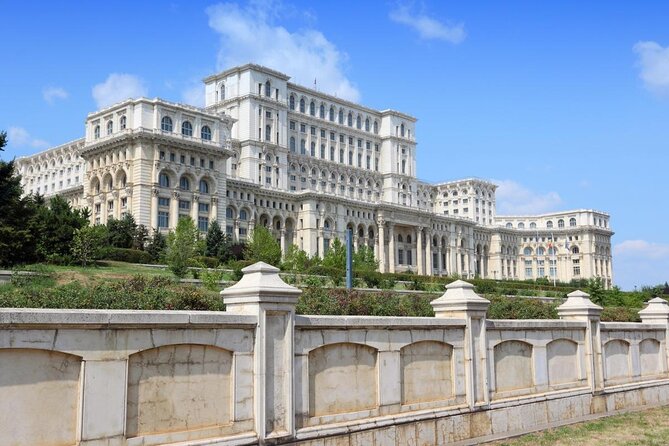
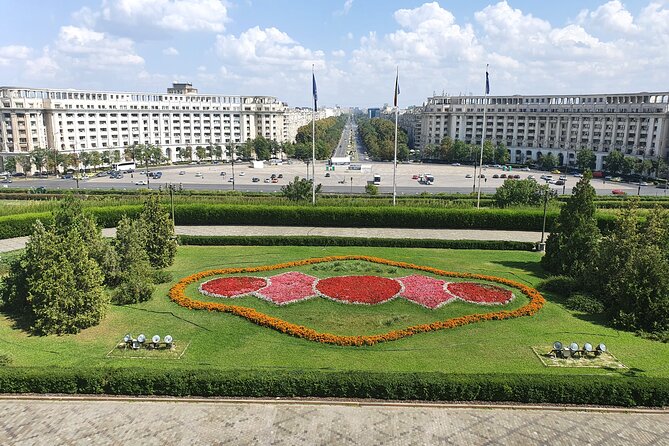
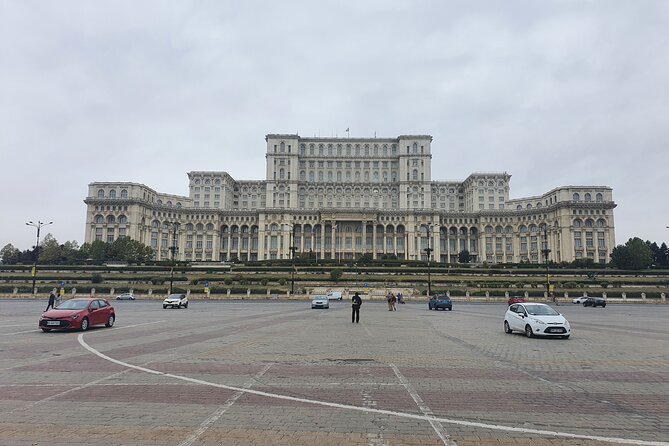
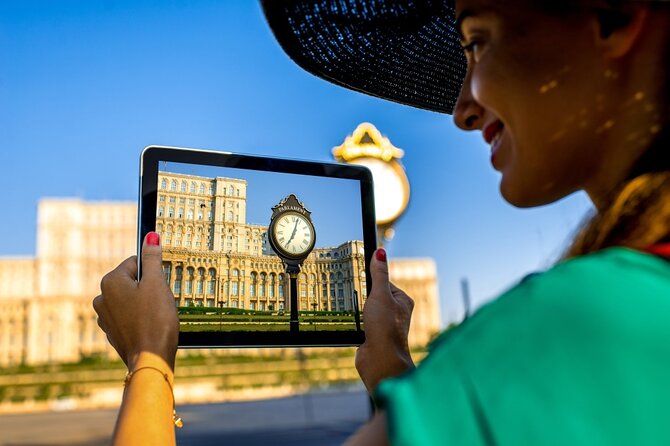
Your first big stop centers on the Palace of Parliament, also called the People’s House. This is not a gentle sightseeing stop. It’s a “see it and feel the scale” moment that’s used to explain how totalitarian regimes can damage a nation—politically, socially, and psychologically.
The building’s scale is the hook. It’s described as the second-largest administrative building on the planet, after the Pentagon. Standing in its orbit gives you a visceral sense of what power looks like when it’s obsessed with itself. The story here isn’t just about the past; it’s about the human cost behind grand projects.
What I like about this stop is that it’s framed as a lesson, not a spectacle. The tour encourages you to notice the contrast between pointless opulence and the realities of everyday life under communism. You’re also asked to think about how megalomania can become physical—material, concrete, massive—until the city itself reflects the regime’s priorities.
Practical note: because this is a political-history anchor of the route, it may feel heavier than the rest of the tour. That’s part of the value. You’ll leave knowing why people still talk about this era in specific places, instead of treating it as a vague timeline.
If you’re traveling with someone who usually finds political history dry, this site can be the workaround. The structure gives the context immediately, and your guide turns that visual impact into clear meaning.
National Village Museum: Romanian homes, sustainability, and identity
Next comes the National Village Museum, a stop that shifts the mood from power to people. The idea is simple: in one place, you can see Romanian traditions expressed through the architecture and life of rural communities.
You’ll view traditional houses built in regional styles—wood and adobe for some areas, stone and other materials for others. The point isn’t to treat them like props. It’s to understand how people lived, how they shaped a home that fit the landscape, and how community and spirituality were part of daily rhythms.
One of the more interesting themes in how this stop is explained is the focus on ecological thinking—how villagers created a sustainable environment in their own backyard. You’ll also get a look at a modest lifestyle presented as social and spiritual harmony with surroundings, not as deprivation.
This is where the tour becomes a useful counterweight to the communist-era sites. You see what people valued beyond politics: continuity, craft, faith, and belonging. For many visitors, it’s a reminder that identity isn’t only carved into monuments; it’s carried in houses, churches, and the textures of daily life.
If you want to photograph, this is also the stop where cameras usually get more action. Wooden structures, symbolic elements, and village details generally create natural “walk-around” photo opportunities, compared with the more monumental feel of parliament buildings.
Senate Palace and December 1989: where the revolution began
Another key part of the route takes you to the Senate Palace area, tied directly to the Revolution of December 1989. This is presented as a moment where the dictator Nicolae Ceaușescu was ousted, and where the story includes both the dramatic upheaval and the shadowy details that followed—like controversies around the state security service and offshore accounts.
The tour links the building to the Central Committee of the Romanian Communist Party, explaining why this space mattered. You’re not just seeing an impressive government structure; you’re connecting a place to a turning point. The revolution is treated as an event shaped by human force and sacrifice, which helps the story land with more weight than a simple date on a wall.
What I find helpful here is the cause-and-effect framing: the regime has a physical center, and when that center is challenged, the city’s meaning changes. That’s a useful idea to carry into the next stops as well.
Timing-wise, this stop fits well inside a short private tour because it’s anchored to a clear story. Your guide can move quickly from location to context, so you get the “why it mattered” piece without needing hours of research first.
If your group is fascinated by political change, this portion is often the most emotionally intense. If your group prefers architecture, it still works: the building becomes a visual clue to what power wanted to look like.
Only your group, at your own speed

Ceaușescu Mansion: the private life behind the regime
From there, the route includes the Ceaușescu Mansion, described as the private residence of Nicolae and Elena Ceaușescu and their children—Nicu, Zoia, and Valentin—covering the period from 1965 to 1989.
This stop is psychologically different from the People’s House. Instead of focusing on the regime’s public face, it narrows the lens to the personal world of the leadership. You’re meant to grasp how a system can create separation between those who rule and those who live with the consequences.
Even if you only spend limited time in the area during a 2-hour tour, the name of the place and what your guide highlights can change how you view it. It stops being just another historical building. It becomes a clue about lifestyle, secrecy, and the contradictions that often grow inside authoritarian systems.
This is also where the tour’s structure feels especially smart. You’ve already studied the regime’s public machinery. Now you see the private bubble around it. That contrast usually helps the whole narrative stick.
If you’re traveling with teens or first-time visitors, this stop can be the easiest bridge to discussions about how politics affects ordinary lives. It’s concrete. It’s human-scale in a way a massive parliament building can’t be.
Arch of Triumph and the Romanian Athenaeum: culture, memory, and symbolism
After the heavy political stops, the tour turns toward landmarks tied to Romanian identity and collective memory.
First is the Arch of Triumph area, described as measuring 27 meters in height and noted as having gone through changes before reaching the design you see today. It’s compared in spirit to the Arc de Triomphe in Paris, which helps visitors calibrate what kind of monument it is: grand, symbolic, and meant to frame stories of national achievement.
Your guide also sets the arch up as a symbol of the fight for freedom. With some luck, you may be able to see four exhibits—about the Great War for the Unification of Romania, heraldry of major boyar families, the arch’s story in pictures and scale models, and the Great Union of 1918.
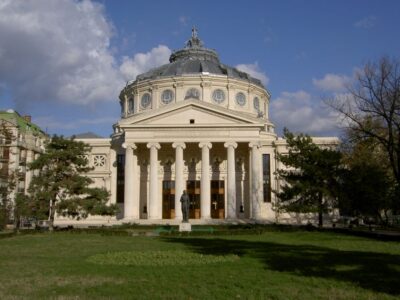
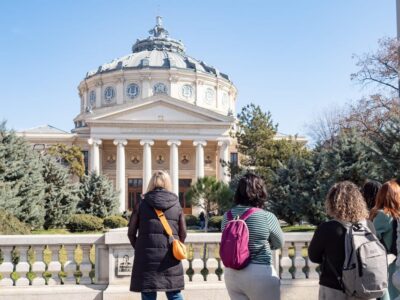
Then comes the Romanian Athenaeum, often treated as one of the most representative symbols of Romanian culture—and frequently linked with Bucharest itself. This is the point in the tour where the city shifts from government drama to art and cultural memory.
I like pairing these two stops because they explain different kinds of national identity. Government power tries to impose meaning from above. Culture and monuments try to keep meaning alive from below, through shared stories and public spaces.
Photography-wise, both stops tend to deliver strong results. Even if you can only glance and move on, the architecture is built for public sightlines.
Bucharest around the Royal Palace and old-city institutions

The final part of your route orbits through major central landmarks: boyar houses, churches, luxury stores, cafes, inns, museums, casinos, state institutions, and statues. If your group wants Bucharest’s everyday texture—beyond just the headline communist sites—this is where you’ll feel it.
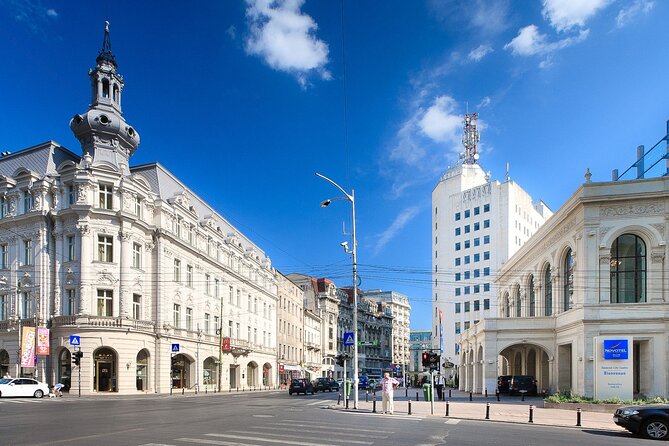
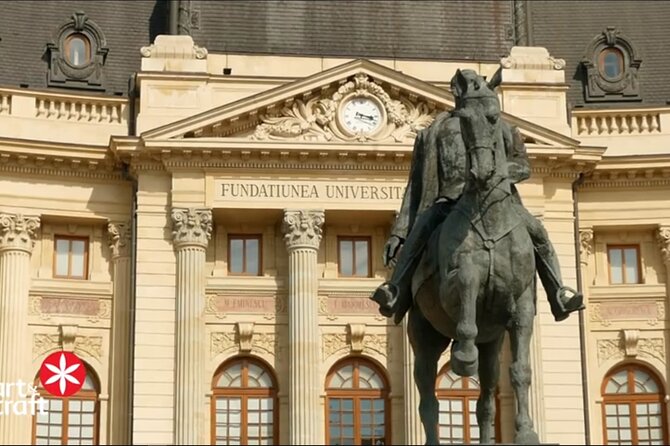
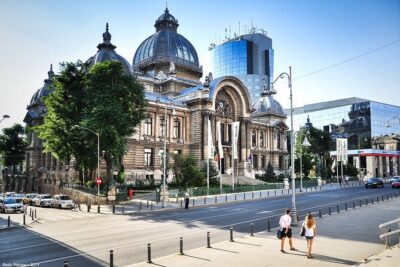
Your tour highlights several major attractions, including the Royal Palace and the National History Museum (formerly the Post Palace). You’ll also hear about the Lady’s Church and the CEC Palace (CEC headquarters), plus the Palace of the National Military Circle and Cantacuzino Palace. The Central University Library and other institutions come into view as part of the broader walk-and-drive context.
This section is also where your guide’s English explanations matter most. You’re seeing a cluster of famous buildings in a short time, so you need someone to tell you what each one represents—what it used to be, what it symbolizes, and why it’s tied to the city’s identity.
A useful way to think about this portion is as a visual map. The landmarks create a mental outline of Bucharest: power, culture, religion, learning, and commerce all show up in the same compact area. When you do this late in the tour, it helps you “place” what you learned earlier.
If you’re the kind of traveler who likes to return later and explore on your own, this is the payoff. You’ll know which buildings to re-visit with more time and which streets to walk to find your own favorites.
Price and value: when $140.58 makes sense
At $140.58 per person for roughly 2 hours, you’re paying for a few specific things: privacy, pickup, and a guide/driver who stays with you the whole time.
Is it expensive? In some cities, a short private tour can feel like a splurge. Here, though, the value depends on what you want to avoid. If you hate coordinating transit, hunting addresses, or paying for multiple taxis between distant sights, the hotel pickup and private car reduce friction fast.
You’re also not paying transport surprises along the way. Car expenses like gasoline, parking, and road tolls are included. That’s a quiet value point that adds up, especially when a tight schedule requires efficient driving.
The other value is time with context. You get English guidance for multiple major landmarks—especially the places tied to communism’s rise and fall—without having to research first. A good city tour is less about checking boxes and more about giving you a framework. That’s what makes it feel worth it.
This tour tends to fit best for:
- Couples or families who want a clean overview without logistical hassle
- First-time Bucharest visitors who want meaning, not just photos
- Groups who can’t spare a full day but still want the major historical anchors
Should you book this private 2-hour Bucharest tour?
Book it if you want a guided, no-stress introduction to Bucharest with strong focus on both political history and cultural identity. The route is designed to hit the big story points early—especially the People’s House and the revolution-era sites—then balance them with Romanian home traditions and national monuments.
Skip it or add extra time if your group hates fast pacing. In a 2-hour format, you’ll get highlights, not deep stays. And since food and drinks aren’t included, you’ll want to plan a meal before or after—especially if the route includes stops that make you want to linger with photos.
If your goal is to leave Bucharest with clearer context and a short list of places to explore later, this private tour is a smart way to start.
FAQ
What’s included in the tour price?
The tour includes a private car for your group, a private licensed English-speaking guide/driver available throughout, and all car expenses such as gasoline, parking, and road tolls. Taxes are also included. Food and drinks are not included.
Does the tour offer hotel pickup and drop-off?
Yes. Pickup is offered, and you’ll get round-trip transfers from your Bucharest hotel.
How long is the Bucharest city tour?
It’s about 2 hours.
What language is the guide?
The tour is offered in English.
Is this a private tour or a shared group tour?
This is a private tour/activity. Only your group participates.
Can I cancel for a full refund?
Yes. You can cancel up to 24 hours in advance for a full refund. If you cancel less than 24 hours before the start time, the amount paid is not refunded.
More Tour Reviews in Bucharest
- Bucharest: Dracula’s Castle, Peles Castle, & Brasov Old Town
★ 4.5 · 17,858 reviews - Bucharest: Dracula Castle, Peles Castle & Brasov Old Town
★ 4.6 · 10,891 reviews - Bucharest: Dracula’s Castle, Peleș Castle & Brașov Day Trip
★ 4.4 · 6,100 reviews - Bucharest: Palace of Parliament Tickets and Guide
★ 4.3 · 3,182 reviews - Bucharest: Day Trip to Dracula Castle, Peles Castle & Brașov
★ 4.4 · 3,049 reviews - Bucharest to Dracula Castle, Peles Castle and Brasov Guided Tour
★ 4.5 · 2,933 reviews
Just the Party You Came With: More Private Days
- Castles of Transylvania: Private Day Trip from Bucharest
★ 4.5 · 248 reviews - Dracula’s Castle, Peles Castle and Brasov – Private Day Trip from Bucharest
★ 5.0 · 211 reviews - Best of Bucharest | Private Walking Tour
★ 5.0 · 199 reviews - Bucharest Panoramic Sightseeing – Private City Tour
★ 5.0 · 128 reviews - THERME “Take It Easy” Pack: Full Spa Access + Private Transfers
★ 4.0 · 117 reviews - 4h Bucharest Private Tour (2h by Car and 2h Walking in Old Town)
★ 5.0 · 90 reviews
All of Bucharest in a Day
- Bucharest: City Highlights Guided Walking Tour
★ 4.9 · 1,482 reviews - Bucharest: Communism and History Guided City Walking Tour
★ 4.9 · 918 reviews - Bucharest Highlights Walking Tour
★ 5.0 · 469 reviews - Bucharest: 2-Hour City Highlights Bike Tour
★ 4.8 · 269 reviews - Best of Bucharest | Private Walking Tour
★ 5.0 · 199 reviews - Bucharest Tuk Tuk city tour
★ 5.0 · 188 reviews
Just In: The Latest Bucharest Reviews


Bucharest City Tours, compared.
 ★ 4.9City Highlights Guided Walking TourFrom $211,482 reviews
 ★ 4.9Communism and History Guided City Walking TourFrom $31918 reviews
 ★ 5.0Bucharest Highlights Walking TourFrom $21469 reviews
 ★ 4.82-Hour City Highlights Bike TourFrom $33269 reviews
 ★ 5.0Best of Bucharest | Private Walking TourFrom $314199 reviews
 ★ 5.0Bucharest Tuk Tuk city tourFrom $54188 reviews
★ 4.9Bucharest Tuk Tuk City TourFrom $58167 reviews
★ 5.0Bucharest Tuk Tuk city tourFrom $54188 reviews
★ 4.9Bucharest Tuk Tuk City TourFrom $58167 reviews
 ★ 4.7Small Group History, Art & Secrets TourFrom $22152 reviews
Browse the lists this tour appears in